

Updated: October 12, 2026
Your District Might Ban AI Next: A Teacher’s Guide to the 2026 School AI Ban Wave
Still using AI to draft your Friday quiz? Somewhere this month, a school board voted so your students never touch the same tools again. The school AI ban teachers are watching in 2026 could reach your district next — here’s how to get ready.
The short version, because you’re probably reading this between classes: in 2026, several major US school districts banned or sharply curbed student-facing AI. Frederick County, Maryland’s board banned student AI use from pre-K through 12 on a 6-1 vote on October 7, New York City hit pause on generative AI for grades 2-K through 8, and LAUSD blocked AI sites on student devices — while teacher AI use for planning and admin stays intact under nearly all of these policies — with one notable exception: New York City explicitly bars teachers from using AI to grade student work.
In this guide you’ll find: a district-by-district map of every major 2026 school AI ban; what these bans mean for your classroom (good news first: teacher AI use survives in nearly all of them); four questions worth sending your district office this week; how to teach AI literacy when students can’t get their hands on the tools; and teacher-side AI tools that keep working after student access gets cut.
TL;DR — the key takeaways
- The 2026 trend is restrictions on student-facing AI, not teacher AI: Frederick County (6-1 board vote, Oct 7), New York City (~600,000 students, grades 2-K-8), LAUSD (~378,000 students), Fairfax County (elementary ban plus an AI-blocking browser extension). The trend even reached National History Day, now barring generative AI from student projects. The first state has also moved: Florida approved statewide AI rules on September 16 (parental opt-in, emotional-companion AI banned in K-12, districts finalize policies by July 1, 2027).
- Everywhere we tracked, teachers can still use approved AI for planning and admin. (The exception: New York City explicitly bars AI from grading student work.)
- Send your district four questions in writing: which AI features are active on student accounts that you can’t monitor, who else can read your students’ chatbot conversations, whether vendors hold real student-data privacy agreements, and how the district plans to teach AI literacy if the tools stay switched off.
- Per a Common Sense Media survey, 59% of students whose school blocked an AI service just moved over to a personal device. Plan for that reality, not a sealed classroom.
How we reported this story
We read the originals, not summaries: TechSpot (Frederick vote), the AP (NYC), The LA Local and LA Wire (LAUSD), FFXnow (Fairfax, October and July), NHD’s official rule (PDF), Compass Vermont, and TechPolicy Press (EU), and Lightspeed’s breakdown of Florida’s Rule 6A-1.0957. Honest limits: Frederick County’s official board minutes weren’t accessible, and coverage conflicts on the ban’s effective date — treat other start dates with care. The EU Kids Act is a proposal — not yet law. Vermont’s guidance dates to January 2026, surfacing widely only this month. (Who’s behind this site? Meet the TeachersTool Team.)
First, the map: every major 2026 school AI ban in one place
Every significant ban, restriction, or guidance move we verified, in one table — then we’ll walk through each, because the details matter for your classroom.
| District / body | Grades affected | What’s banned or restricted | Date | Source |
|---|---|---|---|---|
| Frederick County, MD | Pre-K through 12 | All student AI use (exceptions: AI-literacy lessons, course requirements, extracurriculars, IEP/504 accommodations) | Oct 7, 2026 — board vote 6-1 | TechSpot |
| New York City | Grades 2-K through 8 (moratorium); all grades (chatbots) | Student-facing generative AI for 2026-27; companion chatbots in all grades | Sept 2, 2026 | AP |
| LAUSD | All students (~378,000) | AI-categorized sites and apps blocked on district hardware and signed-in district profiles on personal devices | Sept 2, 2026 | The LA Local |
| Fairfax County, VA | Elementary (ban); 11 elementary/middle schools (extension pilot) | Generative AI forbidden for elementary students; Chrome extension strips AI answers and summaries from Google Search | July 16, 2026 (vote); Oct 8, 2026 (extension reported) | FFXnow |
| Florida (statewide rules) | All public K-12 + 28 state colleges | Emotional/companionship AI banned in K-12; parental opt-in required for student AI use; districts finalize policies | Sept 16, 2026 — compliance by July 1, 2027 | Lightspeed breakdown of Florida’s Rule 6A-1.0957 |
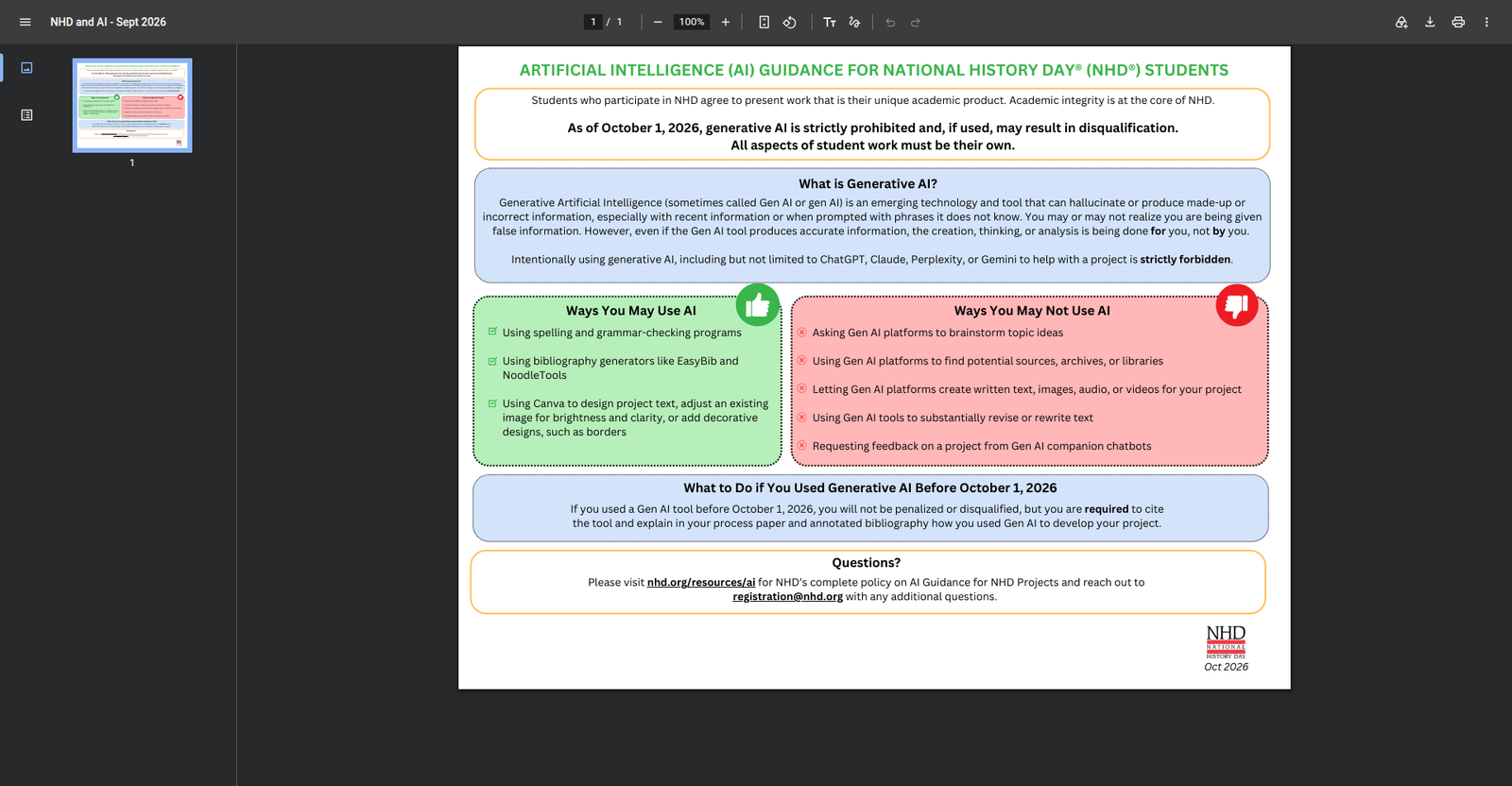
| National History Day | Student competitors | Generative AI for research, analysis, design, or creation of projects | Oct 1, 2026 | NHD official PDF |
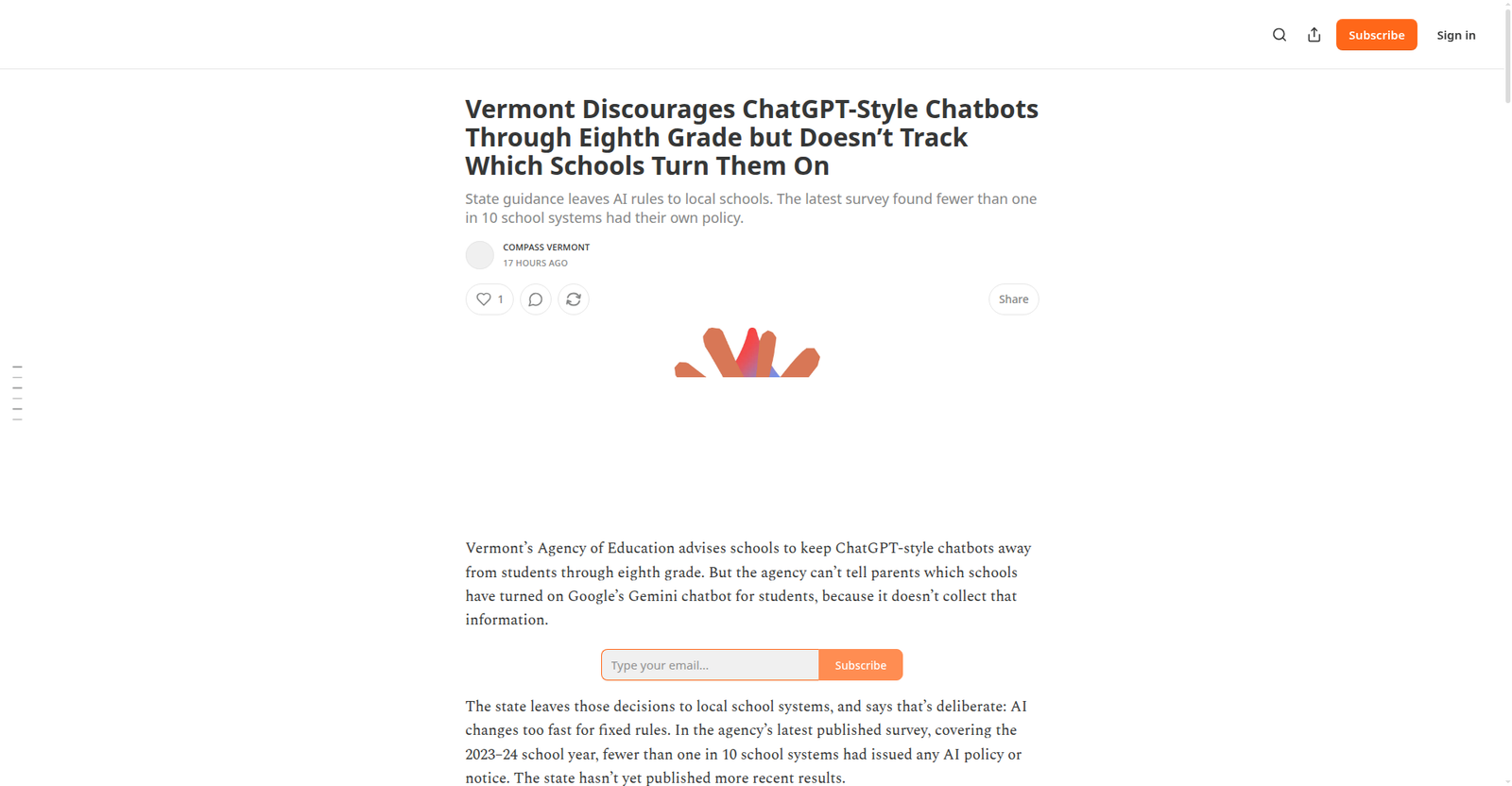
| Vermont (state guidance) | PreK-2 through 12, banded by age | Chatbots discouraged or restricted by grade band; no ChatGPT or Gemini in grades 6-8 | January 2026 (guidance) | Compass Vermont |
| EU Kids Act | Minors (proposal stage) | Design features that create emotional dependency in AI companions and chatbots accessible to minors | Proposed Sept 17, 2026 — not yet law | TechPolicy Press |
Frederick County, Maryland: the sharpest U-turn we’ve seen
If you only read one district’s story, make it this one — the clearest warning of how fast a district can go from “let’s pilot AI” to “shut it all down.”
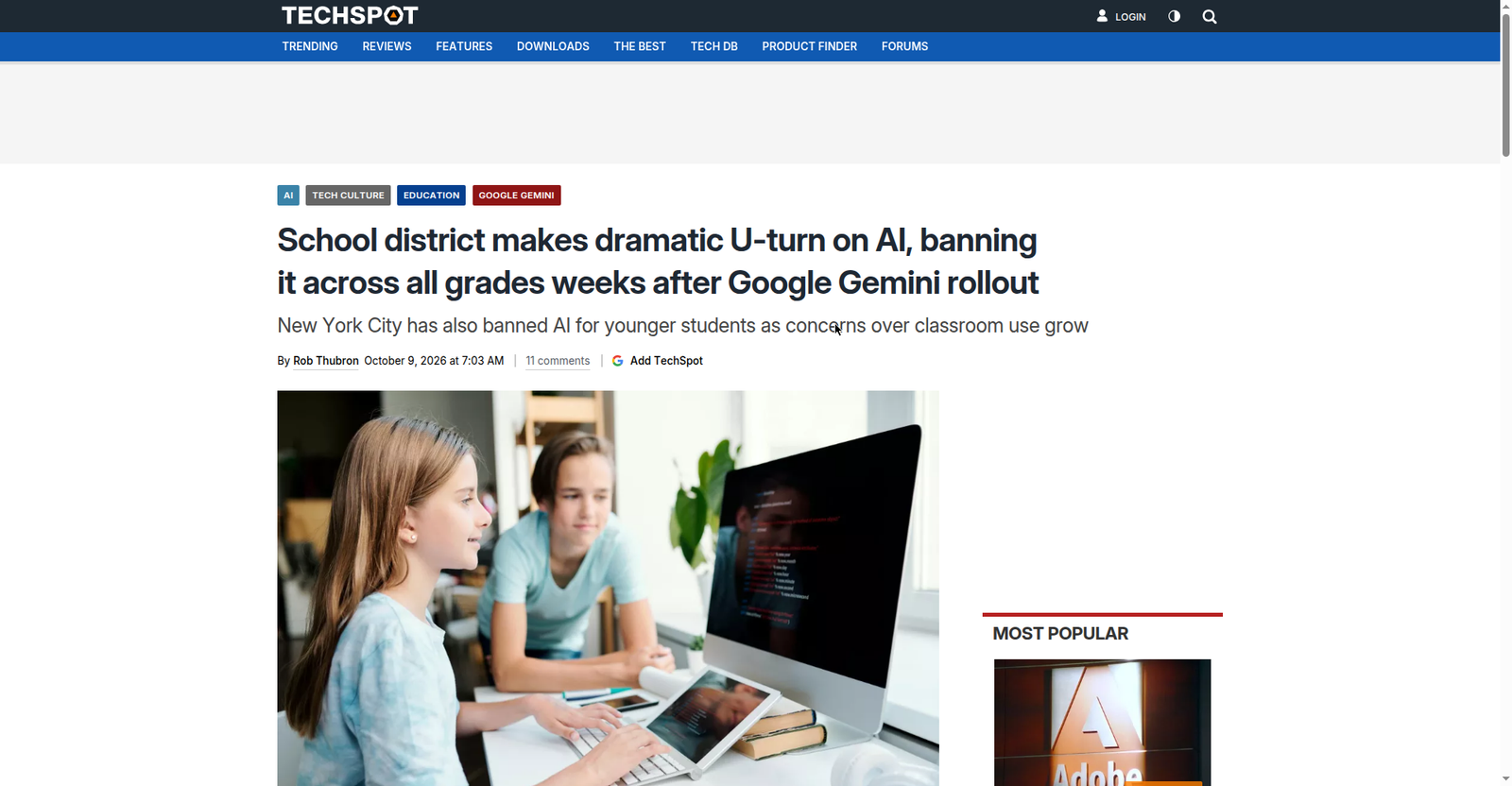
Only weeks earlier, Frederick County had been piloting Google Gemini for middle and high schoolers, with teacher sign-off. The Gemini pick was deliberate: district director Scott Murphy said it was the only evaluated tool that cleared Maryland’s student safety and privacy standards.
Then it fell apart: Gemini switched on with no warning to parents, teachers couldn’t switch it off, and reports surfaced of AI-generated inappropriate student images, bullying, and students taking bad mental-health advice from the chatbot. On October 7, the board’s 6-1 decision banned student AI use pre-K through 12 — carving out only AI-literacy lessons, course requirements, extracurriculars, and IEP/504 accommodations.
The one dissenting vote came from board vice president Rae Gallagher, whose worry was college readiness: students who never practice with AI in school arrive at college — where nobody limits them — with zero supervised experience. She said the quiet part out loud.
What stuck with us: even the “safe, vetted, privacy-compliant” option caused real harm when the rollout skipped the humans. The tool choice wasn’t the failure — the implementation was.
Watch New Mexico too
New Mexico went further than any district on this list: starting with the 2025-26 school year, the state made Amira’s AI literacy assessments mandatory for K-2 literacy and dyslexia screening statewide. When Los Alamos superintendent Jennifer Guy wrote to the state on July 31, she asked the questions every teacher should ask: where are student voice recordings stored, and for how long? Who can access them? Are they used to train or refine the vendor’s AI models? As of her letter, those questions were unanswered.
Amira’s CEO Mark Angel responded on August 28 that the company “does not and will not ever sell student data, or use recordings of New Mexico students to build products,” and the state says recordings are deleted monthly. Still, 18 districts and charters opted out for 2026-27, and reporting has surfaced inaccurate scoring, plus students saying “I don’t like reading anymore.” In a state poll, only 8% of teachers and admins said they had “no major concerns.” (Reported by Elizabeth Nolan Brown, Reason, September 2, 2026.)
New York City: a one-year pause for 600,000 kids
On September 2, 2026, Mayor Zohran Mamdani and Chancellor Kamar Samuels declared a one-year pause on student-facing generative AI for grades 2-K through 8 in 2026-27 — about 600,000 students in the country’s biggest district.
Look closer and the policy is narrower than it first seems: older students get limited supervised pilots plus AI-literacy classes, companion chatbots stay banned at every grade level — which tells you which product type has districts most nervous — plus screen-time caps: 30 minutes a day for grades 3-5, 45 for grades 6-8.
What matters most to you: teachers may still use approved AI for lesson planning and admin. New York didn’t ban AI from schools — it paused student-facing generative AI for younger kids for one year. A pause button, not a verdict — and a possible model for your district.
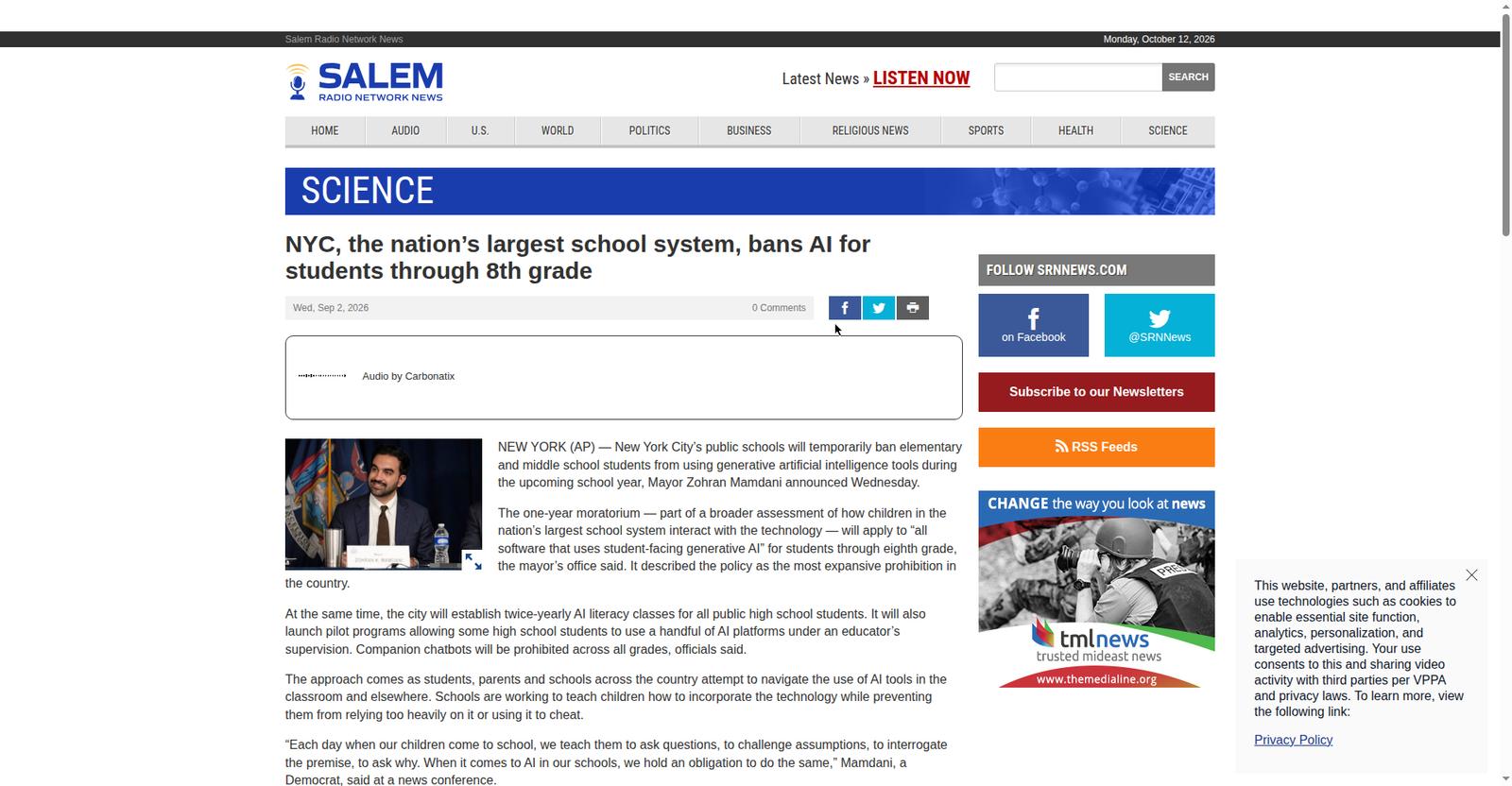
For high schoolers, the city isn’t leaving AI literacy to chance: every high school student will complete two 45-minute AI-literacy modules per year. The policy came together through a stakeholder coalition — the AI Moratorium for NYC Schools Coalition, bringing together parents, teachers, and advocacy groups like Class Size Matters and Climate Families NYC.
Not everyone thinks a year is enough: parent advocates pushed for a two-year moratorium instead. And the state is moving too — New York’s RAISE Act, the second frontier-AI safety law in the US, adds transparency requirements taking effect January 1, 2027.
LAUSD: when the web filter becomes the policy
LAUSD moved the same day — September 2, 2026 — but took a technical route instead of a political one: its Lightspeed web filter now blocks every AI-categorized site and app on district Chromebooks and tablets for 2026-27, affecting roughly 378,000 students.
Two details make this one unusually aggressive: the block travels with the district profile — log into LAUSD on a personal device and the restriction comes with it — and Google AI Mode is switched off on student accounts entirely. AI treated like social media once was: a category to filter, not a tool to manage.
That reverses LAUSD’s earlier position (students 13+ allowed with digital-citizenship instruction). A new Generative AI Ad Hoc Committee met September 2 to draft a permanent policy — so this is explicitly temporary. And once again: teachers were not barred from AI use.
Fairfax County: banning AI inside Google Search itself
Fairfax County, Virginia deserves its own section: its approach is the most technically interesting — and the best preview of where everyone else is headed.
Per October 8 reporting, Fairfax is deploying a county-built Chrome extension that pulls AI-generated answers and summaries from Google Search results on school-issued laptops. It’s piloting at 11 elementary and middle schools with teacher feedback. Not blocking a chatbot site — reaching into the search page to remove the AI layer.
The Fairfax board had already voted on July 16, 2026 to forbid generative AI for elementary students — the extension is enforcement catching up. If your district is wondering “how would we even do this,” Fairfax just handed them a blueprint.
Florida: the first statewide rules
The first statewide framework, not a district vote: on September 16, 2026, the Florida Board of Education approved an amendment to Rule 6A-1.0957 folding AI into internet-safety policy for every public school district, charter, and all 28 state colleges. The shape is different from every ban above — parental opt-in, not prohibition: schools must notify parents before a student uses an AI instructional tool and provide a non-AI alternative for families who opt out. AI designed to simulate friendship or emotional companionship is banned outright in K-12, and PreK-5 tools face extra age-appropriateness review. Districts have until July 1, 2027 to finalize policies — so this one’s a slow burn, but it may become the template other states copy.
It isn’t just districts: National History Day banned AI too
Your students may feel this one before any district policy does. As of October 1, 2026, National History Day — the massive yearly student research competition — ruled: “Students may not use generative AI for research, analysis, design, or creation of their projects.”
Students once used AI for brainstorming topics and finding sources — that’s gone now.
Per deputy director Lynne O’Hara, it’s about protecting “student voice and student thinking,” and it’s not theoretical: two final-round projects across the last two contest cycles cited AI-invented sources.
Still allowed: spelling and grammar checkers, EasyBib and NoodleTools, and Canva for basic design. The line NHD drew works for your classroom: assistive tools fine, thinking tools not. Competing students need to hear this from you before a disqualification.
Vermont: the quiet warning every teacher should read
Vermont banned nothing — but its story might be the most useful one here.
The Agency of Education’s January 2026 guidance (it only surfaced widely this month) sets grade bands: no chatbots for PreK-2, no open-ended chatbots in grades 3-5, school-designed chatbots under teacher direction only in grades 6-8 — no ChatGPT or Gemini — and AI for research in grades 9-12, with pilots and AI lessons.
But the reporting surfaced three facts worth sitting with:
- The state doesn’t know which districts switched Gemini on — as the agency put it: “We do not collect this level of specificity.” The tools went live in classrooms the state couldn’t identify.
- Of 54 surveyed systems, 16 (~30%) hadn’t required vendors to sign student-data-privacy agreements. Pupil data flowed to AI companies with no contract covering it, in almost a third of systems.
- Teachers lacked full visibility into student Gemini conversations — only the district Google admin could review the records, and Gemini activity inside Docs wasn’t logged at all. The adults closest to the students had the least visibility.
Europe is moving too — but don’t hold your breath
One international note: on September 17, 2026, the European Commission proposed the EU Kids Act (COM(2026) 681 final). Article 14 would forbid AI companions for minors from design features “likely to create emotional dependency,” while requiring safer defaults, pre-market risk checks, and a 15+ floor for social accounts. Nothing’s passed yet — but the worry now includes emotional dependency, not just essay cheating.
School AI bans: what’s banned for students vs. still fine for teachers
The honest split across every ban we verified:
| What’s affected | Students | Teachers |
|---|---|---|
| Student accounts on ChatGPT, Gemini, and similar chatbots | Blocked or banned in Frederick, NYC (2-K-8), LAUSD, Fairfax (elementary), Vermont bands | Your teacher accounts are separate — unaffected by student bans |
| AI-generated answers inside Google Search | Blocked on school devices (Fairfax pilot) | Still available on your own devices and accounts |
| Companion / “AI friend” chatbots | Banned for students in NYC (all grades) | Not a classroom tool — no change for you |
| Teacher AI for lesson planning and admin | — | Explicitly allowed in NYC; not barred in LAUSD; not restricted anywhere we tracked |
| AI grading of student work | — | Banned in NYC (teachers may not use AI to grade, monitor behavior, or develop IEPs); other districts we tracked didn’t draw this line |
| AI-literacy lessons | Explicitly excepted from Frederick’s ban | You can — and should — keep teaching them |
| Competition projects (NHD) | No generative AI for research, analysis, design, or creation | Coach your competitors on the new line: assistive tools fine, thinking tools not |
The pattern is consistent: the line is at student-facing generative AI. Your planning workflow isn’t the target — though “not banned” and “approved by my district” aren’t the same thing. Stick to the approved list and keep student names out of your prompts.
What teachers should actually do this week
Deep breath — no need to become a policy expert by Friday. Four questions and one hard truth cover most of what matters.
Question 1: What’s turned on in my district that I can’t see?
Ask your tech coordinator: what’s live on student accounts, and what can you actually see? “We’re not sure” is information too — put it in an email, not a hallway chat.
Question 2: Who can read my students’ AI conversations?
Vermont’s answer was “the district Google admin” — not the teacher, not the parent. Get your district’s answer now, while it’s calm — before a worried parent corners you after pickup.
Question 3: Do our vendors actually have student-data privacy agreements?
Almost a third of Vermont’s surveyed systems skipped them, and “the vendor promised” isn’t a contract. Ask your admin or tech office — somebody should be asking, and it might as well be you.
Question 4: What’s our plan for AI literacy without the tools?
Frederick’s ban explicitly excepts AI-literacy lessons. But a ban without a teaching plan creates a vacuum, and vacuums get filled by TikTok. Ask your department: if students can’t practice with the tools, how do we teach them to understand them? No answer yet — you just found your next PLC topic.
The 59% reality: your students have personal devices
The uncomfortable number: a Common Sense Media survey (via an October 10, 2026 education digest) found 70% of US teens use AI for schoolwork — and of the 44% whose school had blocked an AI service, 59% simply moved to a personal device. The block worked on the school laptop; the student pulled out a phone.
Bans aren’t pointless — they set norms and protect younger kids. But your classroom strategy can’t be “the filter handles it.” Assume students will meet these tools elsewhere: teach them to spot hallucinated citations, question the confident tone, and think twice about pasted data. And the pushback isn’t only top-down: two Colorado high-schoolers petitioned their own board on October 7 to ban classroom generative AI. Some of your students are on your side.
Where unions stand + open enforcement questions
The United Federation of Teachers backed the screen-time limits — president Michael Mulgrew said ‘a ban on individual screen use from 2K through 2nd grade makes sense, as does limiting individual screen time’ — but added that ‘the AI policy, however, leaves many questions unanswered.’ (UFT release, September 2, 2026.)
Three enforcement questions are still open: who actually enforces a ban when students switch to personal devices (remember the 59% who just moved over)? What training will pilot teachers get before the AI-literacy modules roll out? And how will the city evaluate whether those twice-yearly 45-minute sessions actually build AI literacy — or just check a box?
The policy wave isn’t happening in a vacuum: researchers are raising flags about youth mental health and AI, from a 2026 NIH/PMC review asking whether generative AI chatbots increase psychosis risk to the American Psychological Association’s September 2026 brief on what AI is doing to young brains.
Your school AI ban questions, answered honestly
Can teachers still use AI if their district bans it for students?
Yes. Every ban we verified targets student-facing use: New York explicitly allows approved AI for planning and admin, LAUSD didn’t bar teachers, Fairfax’s extension targets student laptops. The practical rules: use your district’s approved tools, keep student names out of public AI tools, and with no approved list, ask before you assume.
How do I teach AI literacy if students can’t use AI tools?
Like driver’s ed without cars — case studies, demos, judgment exercises. Project an AI essay on the board; students hunt the hallucinations. Use Frederick County’s story (a chatbot giving students bad mental-health advice) as your case study — nothing teaches “don’t trust the confident tone” like a true story. Run “spot the AI citation” warm-ups with the NHD incidents. Discuss pasted-data risks using Vermont’s privacy findings. And Frederick’s ban explicitly excepts AI-literacy lessons: teaching about AI is protected even where using it isn’t.
What should I ask my district about AI on student devices?
The four questions above. Ask in writing, keep the replies, and share what you learn with your grade team — one teacher asking gets a shrug; a department asking gets a policy.
Are these bans permanent or just temporary?
Most are moratoriums, not permanent bans. New York City’s is a one-year pause for 2026-27, explicitly time-limited. Frederick County’s board vote bans student AI use indefinitely, but even that can be revisited. Treat every ban as ‘for now’ — districts are waiting to see what works, and policies will evolve as the technology and the research do.
Can I still use ChatGPT on my own laptop or personal device?
Yes — with caveats. These bans target student-facing AI on district accounts and devices. Your personal ChatGPT account on your own laptop is outside their scope. But don’t enter student data (names, work, grades) into any AI tool without checking your district’s data policy first. When in doubt, use it for planning and drafting, not for anything with student information.
What if students just use AI at home on their phones?
They will. A Common Sense Media survey found 59% of students whose school blocked an AI service simply moved to a personal device. Bans don’t eliminate AI use — they move it out of your sight. That’s why the AI-literacy modules matter more than the blocks: teach students to use AI wisely, because you can’t prevent them from using it at all.
Teacher-side tools that survive school AI bans
The good news: these teacher-operated tools need no student accounts — you generate, review, and bring the output to class.
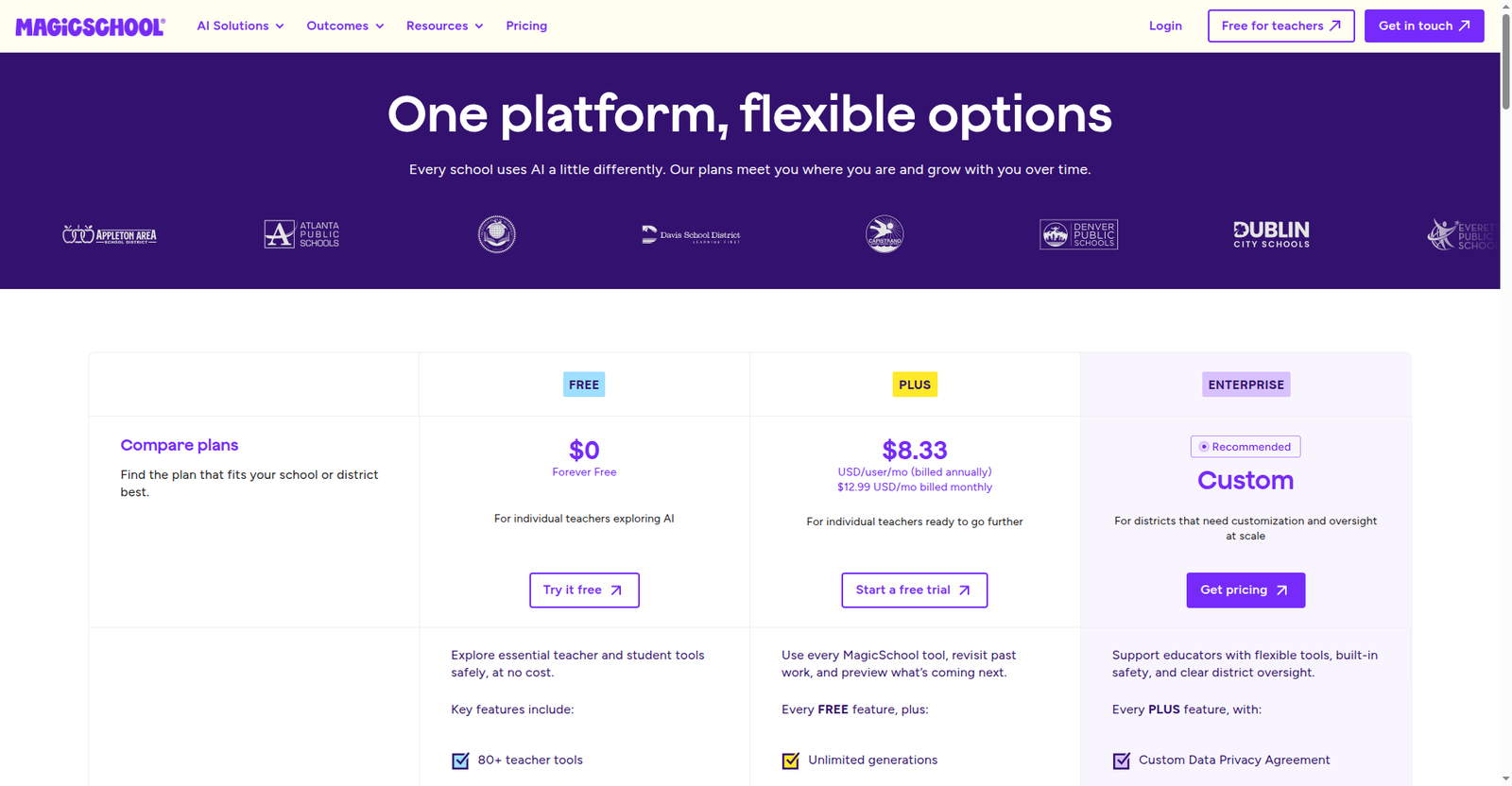
- MagicSchool.ai — the most popular teacher AI toolkit we’ve seen — 80+ tools for lesson planning, worksheets, quizzes, and rubrics. The Forever Free plan costs $0 with limited free generations — enough to try it properly. See our hands-on test of whether AI lesson planning actually works for what these tools do well and where they stumble.
- Eduaide.ai — a quieter, solid option: a free $0 plan with core lesson-plan, worksheet, and quiz generators, limited monthly generations. Less flashy, but the output holds up for the Sunday-night planning pile.
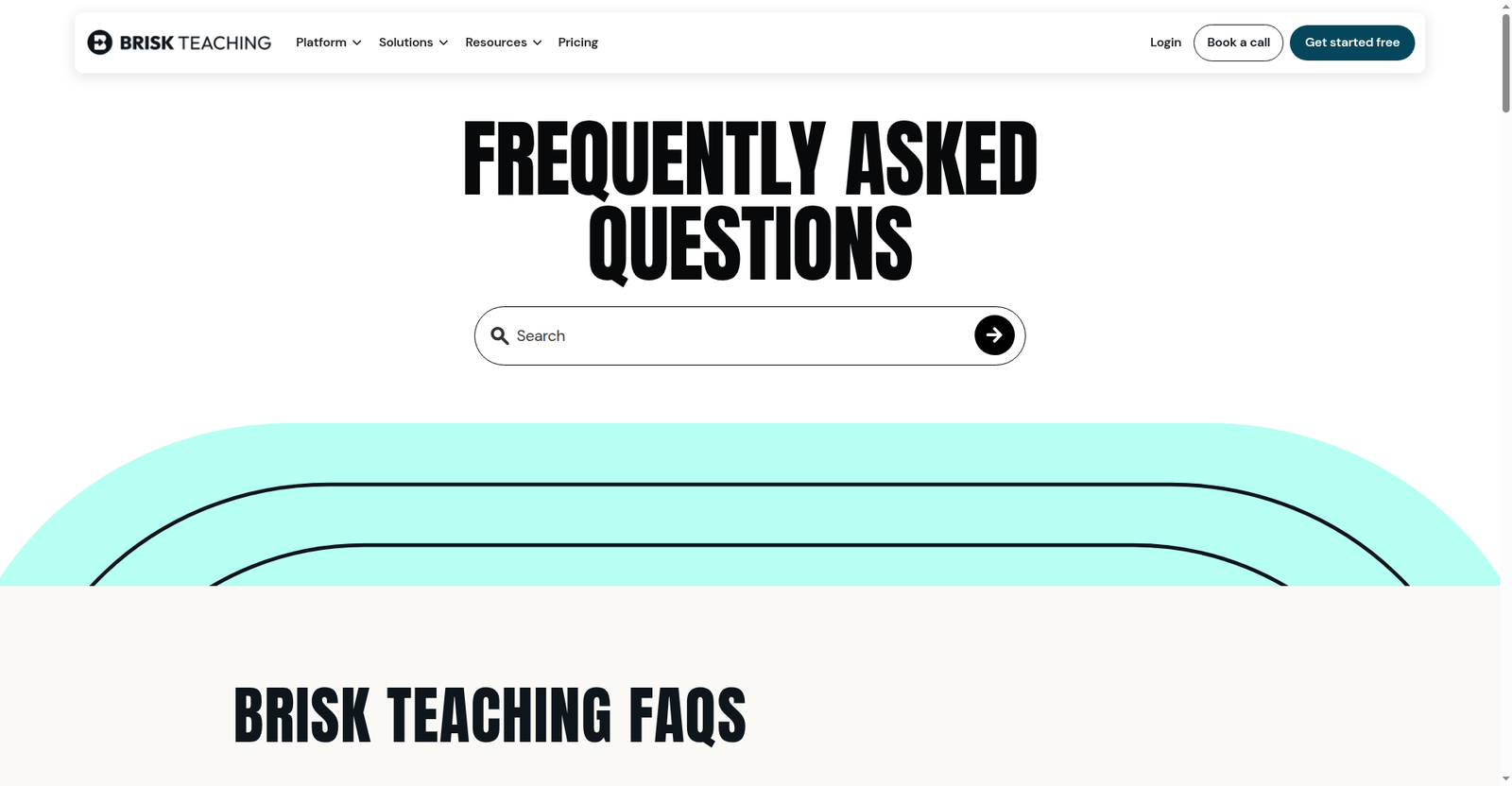
- Brisk Teaching — a completely free Chrome/Edge extension for Google Docs, Slides, and YouTube. Per Brisk’s FAQ, the Free Forever Plan includes 20+ AI tools, teacher-operated by design — the lowest-friction start if your district allows extensions.
One honest caveat: “not banned for students” isn’t “approved by your district for teachers.” Check your district’s list, keep student data out of prompts, and you’re on solid ground.
One last thing before Monday
The ban wave isn’t over — but every district here is pausing student use, not abandoning AI. Nobody on any board believes these tools are going away.
That puts you in the building’s most important seat. The filters will do what filters do. Your job — the part no policy can automate — is teaching judgment: when to trust the machine, when to check it, when to close the laptop and think for yourself. As the school AI ban wave teachers are navigating keeps rolling, your 3rd-period class will need that skill long after today’s headlines fade. Go teach it.
Get One Useful AI Tool Tip Every Week
One practical AI tool tip in your inbox every week. No spam, unsubscribe anytime.

We’re the team behind TeachersTool. We hands-on test AI tools for teachers — signing up for free plans, taking real screenshots, and fact-checking every claim before publishing. Our guides cover lesson planning, quiz creation, grading, and classroom AI workflows.
Enjoying TeachersTool guides?
Add us as a Preferred Source on Google — you'll see our latest tools and guides first in Search, Top Stories, and AI Overviews.